

More and more advertisements for collagen supplements are appearing on social media. As we get older, our body’s collagen starts to break down, which affects our skin, bones, and joints. This means our skin doesn’t look as firm and tight as it used to. Many people take collagen supplements, saying they help with skin, nails, and joints. But what exactly does collagen do? Can these supplements really make a difference? And how can we help our body make more collagen on its own?
What Is Collagen? Types, Structure, and Functions
Our bodies are full of collagen: This protein is a component of connective tissue in bones, skin, muscles, joints, and cartilage. Our bodies constantly produce collagen—it is the most abundant protein in the human organism. There isn’t just one type of collagen, but several different types:
- Type 1 collagen makes up the largest part of human collagen and is found, for example, in skin, bones, tendons, and ligaments.
- In contrast, type 2 collagen is an important component of cartilage.
- Collagen type 3 is also found in the skin, as well as in blood vessels and in the intestines.
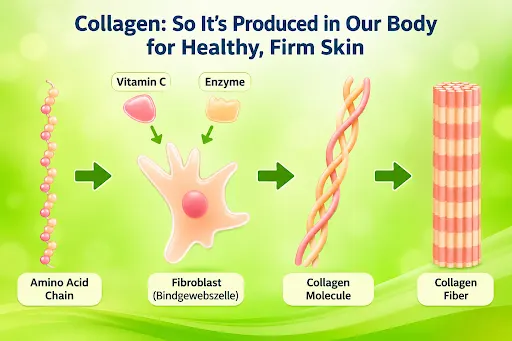
Like all proteins, collagens consist of linked amino acids. In collagen, these are primarily the amino acids proline and glycine. Collagens are built from three chains that form a so-called triple helix—which can be visualized as a tightly woven cord made of three strands of wool. In our bodies, specialized cells called fibroblasts are responsible for much of the collagen production in connective tissues.
What Are the Functions and Benefits of Collagen in the Body?
Collagens are so-called structural proteins. These are proteins that are important for the stability and structure of our tissues. With their fibrous nature, these structural proteins have a supporting, scaffold-like function in various body tissues. They give connective tissue strength and structural support but are also a component of many other body tissues.
Collagens are essential for the body. They are found in almost all areas of the body, including, for example:
- Skin: Beneath the outermost layer of our skin lies the dermis, which is particularly rich in collagen. Collagen helps keep our skin firm and structurally supported.
- Bones: Collagen forms an important part of the organic framework of bones and contributes to bone strength.
- Joints: In the joints, collagen-rich cartilage tissue ensures smooth movement and cushions impacts and jumps.
Good to know: Our hair does not contain collagen: Although the hair root is surrounded by a layer of connective tissue containing collagen, the hair itself consists mostly of dead hair cells.
Do Collagen Supplements Really Work? Benefits of Powders and Capsules
For several years now, collagen supplements have been advertised as miracle cures for skin, hair, nails, and joints. However, the effectiveness of such dietary supplements is controversial.
Do Collagen Creams Improve Skin and Reduce Wrinkles?
They promise to reduce wrinkles and have an anti-aging effect. However, collagen molecules are generally too large to penetrate the skin deeply, although topical collagen can help retain moisture on the skin’s surface. Furthermore, the body’s own collagen is located in the deeper layers of the skin—even if the skin could absorb collagen from creams, it’s unclear whether it would actually reach those layers.
Do Collagen Powders and Capsules Work?
Some studies have reported improvements in skin hydration, elasticity, and wrinkles after taking collagen supplements. However, a 2025 systematic review and meta-analysis found that these benefits were not evident in studies without pharmaceutical industry funding or in high-quality studies. The authors concluded that there was currently no clinical evidence supporting collagen supplements for preventing or treating skin aging.
Collagen supplements are digested into amino acids and smaller peptides. Some collagen-derived peptides can enter the bloodstream, but it is not yet clear how much reaches specific tissues or whether the process produces meaningful health benefits.
Due to a lack of scientific evidence, specific health claims that collagen-containing dietary supplements, such as collagen powder, improve skin structure or joint health have not been authorized in the EU. Manufacturers attempt to circumvent this prohibition by adding substances with proven effects to the products, such as certain vitamins.
Collagen Supplements: Possible Side Effects and Risks
The fact that collagen supplements like collagen powder have not shown any demonstrable effect on skin and joints in studies does not mean that these products cannot have any side effects. Products containing collagen can trigger allergic reactions. The risk is particularly high for people with fish allergies, as the collagen is partly derived from fish skin.
Collagen supplements sometimes also contain added vitamin B3 (nicotinamide/nicotinic acid). High doses of nicotinic acid, a form of vitamin B3, can cause facial flushing and a sensation of warmth. Piperine, an extract from black pepper, is often used to enhance the absorption of other active ingredients. According to safety recommendations, adults should not consume more than two milligrams of isolated piperine per day from food supplements, and pregnant women are advised to avoid taking it.
Are Collagen Supplements Vegan?
If you are considering taking collagen supplements, please bear in mind that conventional collagen supplements are derived from animal sources, including pigskin, fish, and cattle.
Products containing so-called vegan collagen usually consist of a mixture of various amino acids. Many products marketed as vegan collagen contain amino acids or other ingredients intended to support collagen production rather than collagen itself.
How Can You Naturally Support Your Body’s Collagen Production?
Yes. Instead of swallowing expensive supplements, it’s more worthwhile to support your own body’s collagen production. Furthermore, a healthy lifestyle protects the collagen fibers in the tissues from damage or breakdown.
1. Protect Your Skin From Sun Exposure
Sun protection: Sunlight inhibits collagen production and promotes the breakdown of collagen fibers in the skin. Sunscreen, covering the skin, and avoiding midday sun prevent this.
Also Read: Protect Yourself From The Sun: 10 Tips To Stay Calm
2. Avoid Smoking
Don’t smoke: Smoking damages the collagen fibers in the skin, making it looser and less elastic.
3. Limit Alcohol Consumption
Abstaining from alcohol: The effects of alcohol consumption on collagen production in humans are not yet well established.
4. Exercise Regularly
Exercise: Exercise may influence collagen turnover in connective tissues, but evidence about its effects on collagen production in humans is still limited.
5. Eat a Balanced, Protein-Rich Diet
A balanced diet: To support collagen production through diet, it can be helpful to focus on protein-rich foods. Amino acids important for collagen production, such as glycine and proline, are found in fish, poultry, dairy products, soy, eggs, and legumes. Zinc (found in nuts, meat, and legumes) and vitamin C (found in citrus fruits, bell peppers, and leafy greens) are also important for the body’s own collagen production. While collagen itself is present in many foods like meat, fish, and gelatin, it is broken down into amino acids and smaller peptides during digestion, some of which can enter the bloodstream.
Also Read: Beneficial Effects For The Body And The Mind Of Good Food
6. Get Enough Quality Sleep
Good sleep: Adequate sleep supports normal tissue repair. However, direct evidence linking sleep duration to collagen production in humans is limited.
7. Manage Stress
Reduce stress: Prolonged exposure to high cortisol levels can reduce collagen production, although the direct effect of everyday psychological stress on collagen levels is not fully established.
How Does Collagen Production Change With Age?
As we age, the body produces less collagen. Furthermore, age-related changes in the skin’s structure and composition contribute to reduced firmness and elasticity, and environmental factors, particularly UV exposure, can damage collagen structures in deeper layers of the skin over time. This results in less firm and elastic skin, making it somewhat looser—a completely natural process that dietary supplements cannot alter. However, you can best support your body’s own collagen production, even in old age, through plenty of exercise, sufficient sleep, and a balanced diet.